
October 5, 2026 / 5 min read
How to Brief a Video Editor for Music Ad Variations
A copyable editor brief that turns one shoot into genuinely different, testable ad variations instead of three near-identical cuts.
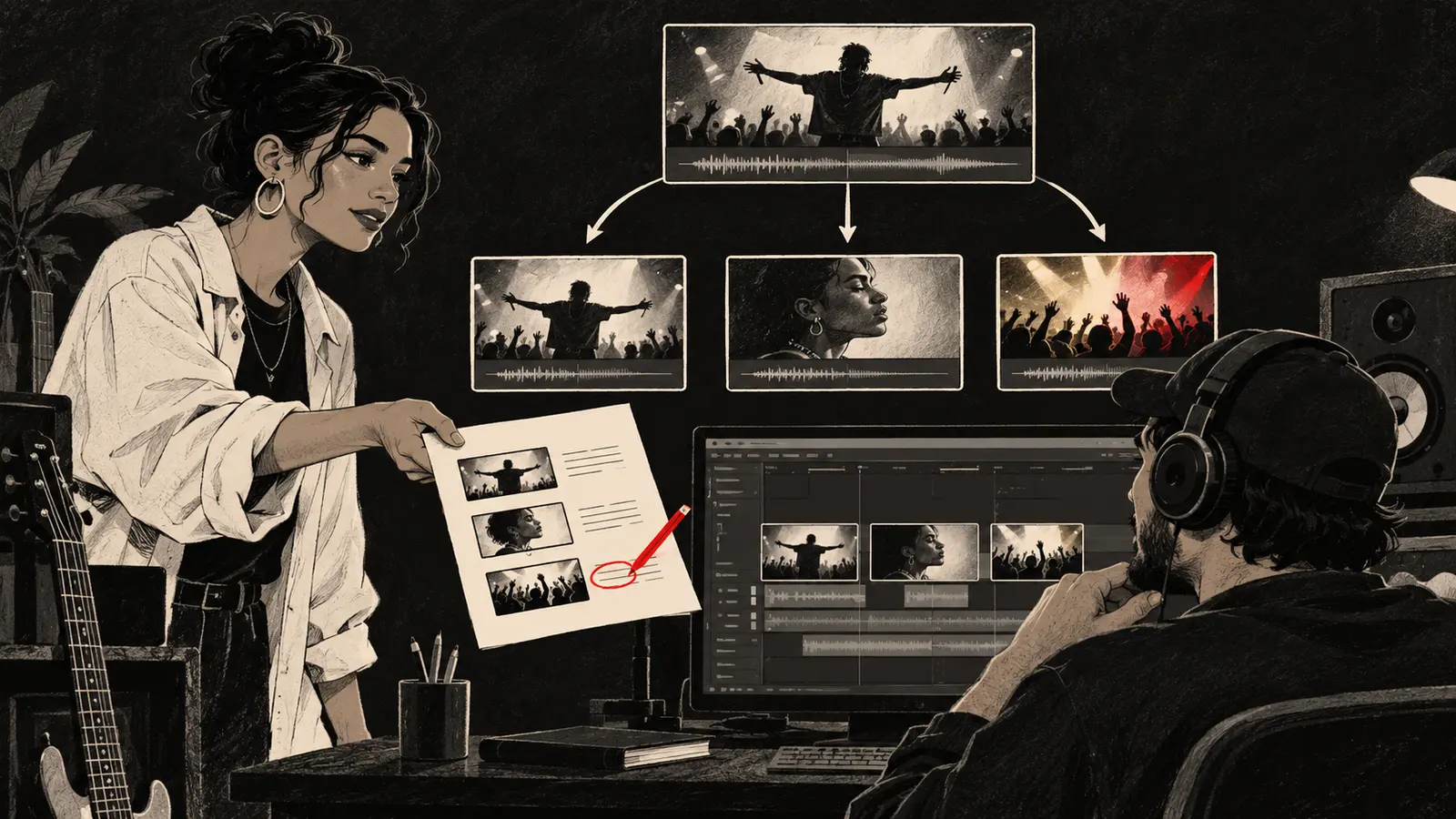
You hand an editor a folder of footage and ask for "a few ad versions." Three days later you get back three edits that are almost identical: same opening, same hook, slightly different color grade. Nothing to test.
The problem is rarely the editor. It is the brief. A useful brief turns one shoot into variations that are genuinely different in the ways that matter for advertising, so every version answers a question. This guide gives you a structure you can copy for your next release.
If you are still planning the release itself, work through the music release strategy checklist first so the ad creative fits the wider rollout.
What makes a variation testable
A testable variation changes one meaningful idea while keeping everything else steady. Useful dimensions to vary:
- the hook: which part of the song opens the ad
- the first visual: what the viewer sees in the opening second
- the angle: what the ad is really about (the artist, the lyric, the scene, the live energy)
- the text: on-screen line or caption that frames the song
Things that are usually not worth testing on their own at the start: small color changes, transition styles, font choices, slightly different cuts of the same sequence. These may matter later, but they rarely move early results enough to learn from on a small budget.
The brief, section by section
Copy this structure into a document and fill it in before the editor opens the footage.
1. Context
Two or three sentences on the song, the artist and the release goal. For example: "Second single from an upcoming EP. Moody indie pop. Goal is to find new listeners who save the track, not just clicks."
2. Audio
- Link to the master and any stems or instrumentals
- Timestamps for each hook candidate you want used
- Instruction to start every edit on sound with no silence or count-in
- Instruction to keep loudness consistent across versions
3. Footage inventory
List what exists and where: music video selects, performance clips, behind-the-scenes, photos, lyric graphics. Flag any shots you consider strongest and any that are off-limits.
4. The variation matrix
This is the core of the brief. Define each version as a deliberate idea:
| Version | Angle | Opening visual | Hook | Text on screen |
|---|---|---|---|---|
| A | Performance energy | Close vocal shot, crowd behind | Chorus line at 1:02 | None |
| B | Lyric story | Hand-written lyric card | Verse line at 0:31 | The lyric itself |
| C | Visual world | Most striking video frame | Chorus line at 1:02 | Short scene-setting line |
Notice that A and C share a hook but differ in angle and visuals, while B changes the hook too. Be explicit about what each version is testing so the editor protects that difference.
5. Format and deliverables
Spell out exactly what files you need:
- aspect ratios (for example vertical and square versions of each)
- target durations (a short cut and a slightly longer cut, if useful)
- file naming convention, such as
SongName_A_vertical_short.mp4 - whether you need a captioned and an uncaptioned version
- export settings or platform specs if you have them
A clear naming convention saves hours later when you are reading results and need to know exactly which file is which.
6. Captions and safe zones
Ask for burned-in captions only where they help, and keep important visuals and text away from the edges where platform interface elements can cover them. If you are placing ads on Instagram, see how to promote your music on Instagram for how placements differ.
7. What not to do
Editors appreciate clear limits:
- no logo or title card at the very start
- no slow fade-in from black
- no text over the artist's face
- no music that is not from the track
8. Review process and timeline
State who gives feedback, how many rounds are included, and the delivery date. Ask for a rough cut of one version first so you can correct direction before all versions are finished.
Give the editor the reason, not only the request
An editor who understands why you want three distinct versions will make better choices within them. Explain that each version is a hypothesis you plan to test with paid spend, and that similarity between versions wastes budget. That one sentence tends to change the output.
Reviewing the first cut
When the rough cut arrives, check it against the brief rather than your taste:
- Does it open on sound and motion in the first second?
- Is the intended angle obvious within a few seconds?
- Would a stranger understand what they are looking at without context?
- Does it sound good on a phone speaker at low volume?
- Is it clearly different from the other planned versions?
If a version fails the fifth question, fix that before polishing anything else.
After the test: feed the results back
Once the variations have run, share what you learned with the editor. Tell them which angle held attention in the ad platform and, separately, whether listening behavior in your streaming analytics seemed to follow. Ad metrics show attention and clicks; saves and repeat listens show whether that attention turned into listeners. Editors who see results make sharper second rounds.
A copyable checklist
- Context and goal in two or three sentences
- Master audio and hook timestamps
- Footage inventory with favorites and exclusions
- Variation matrix with one clear idea per version
- Formats, durations, naming, captioned and uncaptioned
- Safe zones and a "do not" list
- Review rounds and delivery date
- Plan to share results after the test
FAQ
How many variations should I ask for? Three distinct ideas is a practical start for most budgets. More versions split spend thinner and make results harder to read.
Should I let the editor come up with angles? Invite suggestions, but decide the matrix yourself. The brief should reflect what you want to learn.
Can one shoot really produce three distinct ads? Usually, yes, if you plan for it. Capture close-ups, wide shots, performance takes and a few personal moments on the day so the editor has options.
Let Shuffle handle the creative pipeline
Briefing, editing and testing variations takes time on every release. If you want a team that plans creative around measurable tests, apply to work with Shuffle.
Want this run on your release?
We take on a limited number of artists and labels, and we read every application ourselves.
Apply to Work With Us