
October 5, 2026 / 6 min read
How to Choose a Song Hook for a Music Ad
How to find, edit and test the short musical moment that opens a paid social ad, and why your favorite part of the song is not always the right hook.
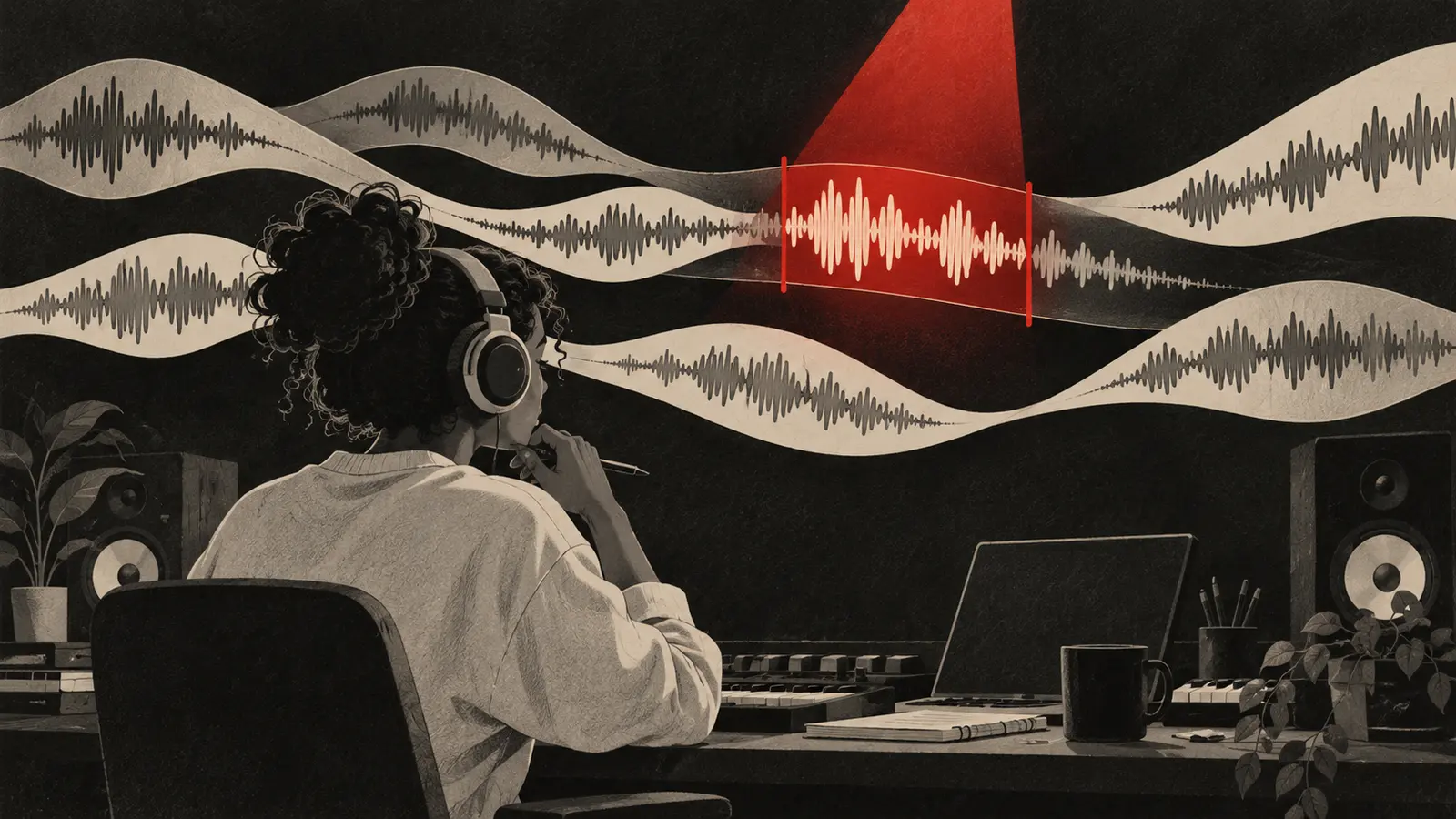
The first two seconds of a music ad decide whether anyone hears the next ten. Most artists pick the section they love most, usually the chorus, and drop it at the start of the video. Sometimes that works. Often it does not, because the best musical moment in a song and the best opening for an ad are two different things.
This guide walks through how to find hook candidates, edit them for a paid social feed, and test them in a way that tells you something real. If you have not yet checked whether the track itself is a good candidate for spend, start with is your song ready for paid promotion.
Why the favorite part is not always the right hook
A chorus often lands because of everything that came before it. The verse builds tension, the pre-chorus lifts, and the drop pays it off. Cut straight to the payoff in a feed, and the listener has none of that context. What felt huge in the full track can feel flat or confusing in isolation.
An ad hook has a narrower job. It has to:
- make sense with no build-up
- sound intentional on a phone speaker at low volume
- give a scrolling viewer a reason to stay for a few more seconds
- represent the song honestly, so the people who stay are people who will like the full track
That last point matters. A hook that stops the scroll but misrepresents the song can bring cheap attention from people who never save or replay it.
Find three to five hook candidates
Listen through the track with a timer open and mark every moment that could stand on its own. Good candidates tend to fall into a few types:
| Hook type | What it sounds like | When it tends to suit |
|---|---|---|
| Vocal line | A distinctive lyric or melody, sung clearly | Lyric-driven songs, strong vocal identity |
| Instrumental riff | A signature guitar, synth or sample figure | Electronic, rock, beat-led tracks |
| Drop or impact | The first hit after a build | Dance and bass music, high energy edits |
| Texture or intro | An unusual sound that creates curiosity | Alternative, ambient, experimental work |
| Spoken or ad-lib moment | A voice note, laugh or shout | Artists with strong personality content |
Aim for three to five candidates across at least two types. If every option is a variation of the chorus, you are only testing one idea.
Edit each hook for the feed
Once you have candidates, prepare them so the comparison is fair.
- Start on the sound, not before it. Trim any silence or count-in. The first frame of the video should already carry audio.
- Keep the clip short. Pull a clean segment you can loop or extend. You can always let the ad run longer, but the opening is what you are testing.
- Check it on a phone. Play each clip through the phone speaker at half volume. Bass-heavy hooks often disappear; a vocal line or bright riff may carry better.
- Match loudness across clips. A louder clip will feel stronger for reasons that have nothing to do with the music. Normalize so you are comparing the hooks, not the mastering.
- Use the same visual for every candidate. If one hook sits on better footage, you are testing footage.
Add captions or on-screen text only if every version gets the same treatment. Text can change results more than the audio does.
Decide what a winning hook looks like before you spend
Write down your decision rule before launching. Ad platforms will show you plenty of numbers, and it is easy to pick the one that flatters your favorite.
Early signals the ad platform reports:
- how much of the video people watch in the first few seconds
- how many viewers keep watching to the end
- click-through rate to your streaming link
What those signals do not tell you is whether the people who clicked actually listened, saved or came back. Those behaviors live in your streaming analytics, not the ad dashboard. Keep the two separate in your notes. A hook with strong early retention but no visible lift in saves or repeat listens is an attention hook, not necessarily a fan-building one. For more on that gap, see what ad clicks and streams actually measure.
A simple rule might be: pick the hook that holds viewers best in the opening seconds, as long as its click quality is not clearly worse than the others. Then confirm over the following weeks in your streaming data.
Run the hook test
Keep the setup plain:
- one campaign, one audience, one objective
- one ad per hook candidate, identical except for the audio segment
- the same budget per ad, or a structure that splits delivery fairly
- enough time for each version to get a meaningful amount of delivery
Do not change targeting, copy or visuals halfway through. If one hook runs away with early delivery, let the test continue a little longer before judging, since platforms often favor a version before the data is solid.
If you are new to setting up this kind of campaign, the fundamentals in Meta ads for musicians cover structure and objectives.
Read the result carefully
When the test ends, look at three questions in order:
- Did one hook clearly hold attention better? Small differences are often noise. Look for a gap you would still believe if you ran it again.
- Did the clicks look like listeners? Compare the ad data with what happened in your streaming analytics over the same period. You cannot tie individual clicks to individual streams, but you can watch for patterns.
- Does the winner represent the song? If the strongest hook is a quirky intro that sounds nothing like the rest of the track, treat that result with caution.
Keep the losing hooks. A hook that underperformed in one audience may do well in another, or with different footage later.
Common hook mistakes
- Starting with a logo or title card. The viewer came for the feed, not your branding. Lead with sound and motion.
- Using the full chorus. A whole chorus is too long for an opening. Find the strongest line or bar inside it.
- Testing hooks and visuals at the same time. You will not know which change mattered.
- Picking the winner on a single day. Daily numbers swing. Judge over the full test window.
- Ignoring the phone speaker. Most people will hear your hook on small speakers or with sound low.
A quick checklist
- Three to five hook candidates, at least two types
- Each clip starts on sound and is loudness-matched
- Identical visual and text across versions
- Decision rule written before launch
- Ad signals and streaming behavior tracked separately
- Winner confirmed against saves and repeat listens, not only clicks
FAQ
How long should a music ad hook be? There is no fixed length. What matters is that the very first moment carries the idea. Test the opening, then let the ad continue long enough to give an interested viewer more of the song.
Should the hook always be the chorus? No. Test it as one candidate alongside a verse line, riff or intro. The chorus wins often enough to include, not often enough to assume.
Can I reuse a hook across releases? The method, yes. The result, no. Each song and audience needs its own test.
Get help choosing and testing hooks
Picking the right opening is one of the highest-leverage creative decisions in a music campaign. If you want a team to plan and run this kind of testing on your next release, apply to work with Shuffle.
Want this run on your release?
We take on a limited number of artists and labels, and we read every application ourselves.
Apply to Work With Us