
May 6, 2026 / 4 min read
How to Get on Spotify Playlists in 2026: The Complete Guide
Placement is a result, not a strategy. Here is what actually drives Spotify distribution in 2026 and how to create it on demand.
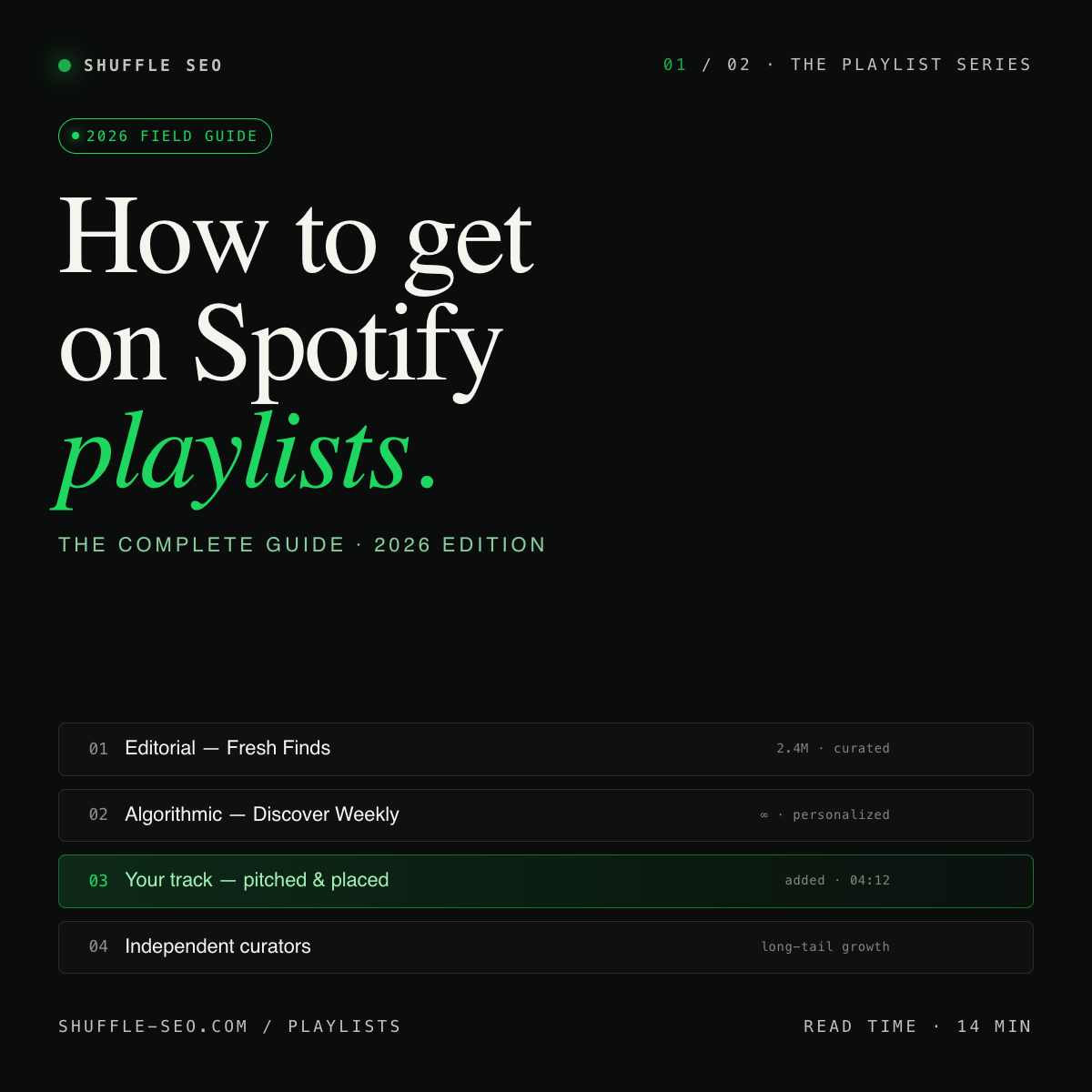
Every artist wants the same thing: more people hearing the music on Spotify. For years the assumed route was pitching playlists. In 2026 that route is crowded, slow, and mostly out of your hands.
There is a better way to think about it. Playlists are a result, not a strategy. They follow real listener behaviour. If you can create that behaviour on demand, placement stops being something you beg for and becomes something the platform gives you.
This guide explains what actually drives placement in 2026, and how Shuffle builds campaigns around it.
What Spotify Is Actually Looking For
Spotify's systems do not care how many curators you emailed. They read behaviour:
- Save rate
- Completion rate
- Skip rate in the first 30 seconds
- Repeat listens over the following days
- Follows on the artist profile
- Whether listeners return without being prompted
When a track produces those signals consistently, the platform starts distributing it on its own through Discover Weekly, Release Radar, Radio and Autoplay. That distribution is worth far more than a single placement, because it compounds and it does not expire.
The Three Kinds of Placement
Editorial. Curated by Spotify's own team. You submit through Spotify for Artists at least seven days before release. It is free, it costs you nothing but time, and you should always do it. Just do not build a plan on it.
Algorithmic. Generated automatically per listener. This is where the real volume lives, and it is the only category you can directly influence with your own campaigns.
Third party. Everything else. Quality varies enormously and paid placement schemes are the fastest way to poison an artist profile with traffic that does not behave like a fan.
Step 1: Get the Release Fundamentals Right
None of this works on a weak setup.
- Deliver to your distributor three to four weeks before release date.
- Submit the track through Spotify for Artists as an unreleased song.
- Complete the artist profile: bio, images, artist pick, social links, canvas.
- Make sure the first fifteen seconds of the track earn the next fifteen.
Retention is a production decision as much as a marketing one. If listeners drop at 0:20, no amount of spend will fix the numbers.
Step 2: Buy Attention, Then Measure Behaviour
This is where Shuffle campaigns start. We run paid traffic on Meta, TikTok, YouTube and Google, pointed at a landing page that is built to convert to Spotify rather than just to click.
The landing page carries a pixel. That means every visit, every click through to Spotify, and every retargetable action is recorded. Within days you know:
- Which creative angle produces listeners rather than scrollers
- Which country and age band actually saves the song
- Which placement gives you the cheapest qualified listen, not the cheapest click
That data is the asset. It survives the release and it makes the next one cheaper.
Step 3: Test Creative in Volume
One video is a guess. Twenty variations is a test.
We test hooks, opening frames, song sections, captions, edit pace, and calls to action against each other. The winners get scale, the losers get cut inside 48 hours. The point is not to find the cheapest impression. It is to find the specific combination of song moment and audience that produces saves.
Step 4: Retarget the People Who Showed Intent
Most campaigns stop at the first click. That is where the money is left on the table.
Anyone who visited the landing page, watched most of the video, or engaged with the ad goes into a retargeting pool. Those people get a second and third touch, and they convert at a fraction of the cost of cold traffic. Repeat listens over consecutive days are exactly the signal Spotify reads as genuine interest.
Step 5: Read Spotify for Artists Like a Dashboard
Streams alone tell you very little. Watch:
- Save rate. The single strongest signal. Above roughly 10 percent of listeners is healthy.
- Listeners to streams ratio. Higher means people are coming back.
- Source of streams. Watch the share coming from Spotify's own algorithmic sources climb. That is the campaign working.
- Followers gained. A follower is a permanent distribution channel through Release Radar.
When algorithmic sources start growing while your ad spend stays flat, the platform has taken over and placement follows.
What Not to Do
- Do not buy streams or bot traffic. It flattens your save rate, it is detected, and it can get a release pulled.
- Do not pay for guaranteed placement. Guarantees exist because the traffic is not real.
- Do not judge a campaign on day three. Algorithmic distribution builds over two to six weeks.
- Do not run traffic to a track that cannot hold a listener. Fix the song first.
The Short Version
Getting on Spotify playlists in 2026 is downstream of one thing: proving to the platform that real people respond to your music. Paid campaigns, tested creative, a pixelled landing page and honest reading of the data are how you prove it repeatedly instead of once.
That is the entire Shuffle model. We put spend behind the music, measure what listeners actually do, and let the platform do the distribution.
Want this run on your release?
We take on a limited number of artists and labels, and we read every application ourselves.
Apply to Work With Us