
October 5, 2026 / 5 min read
Performance Footage vs Music Video Clips in Paid Ads
Live clips and polished video moments signal different things to a scrolling viewer. Here is how to prepare both fairly, test them and read the result.
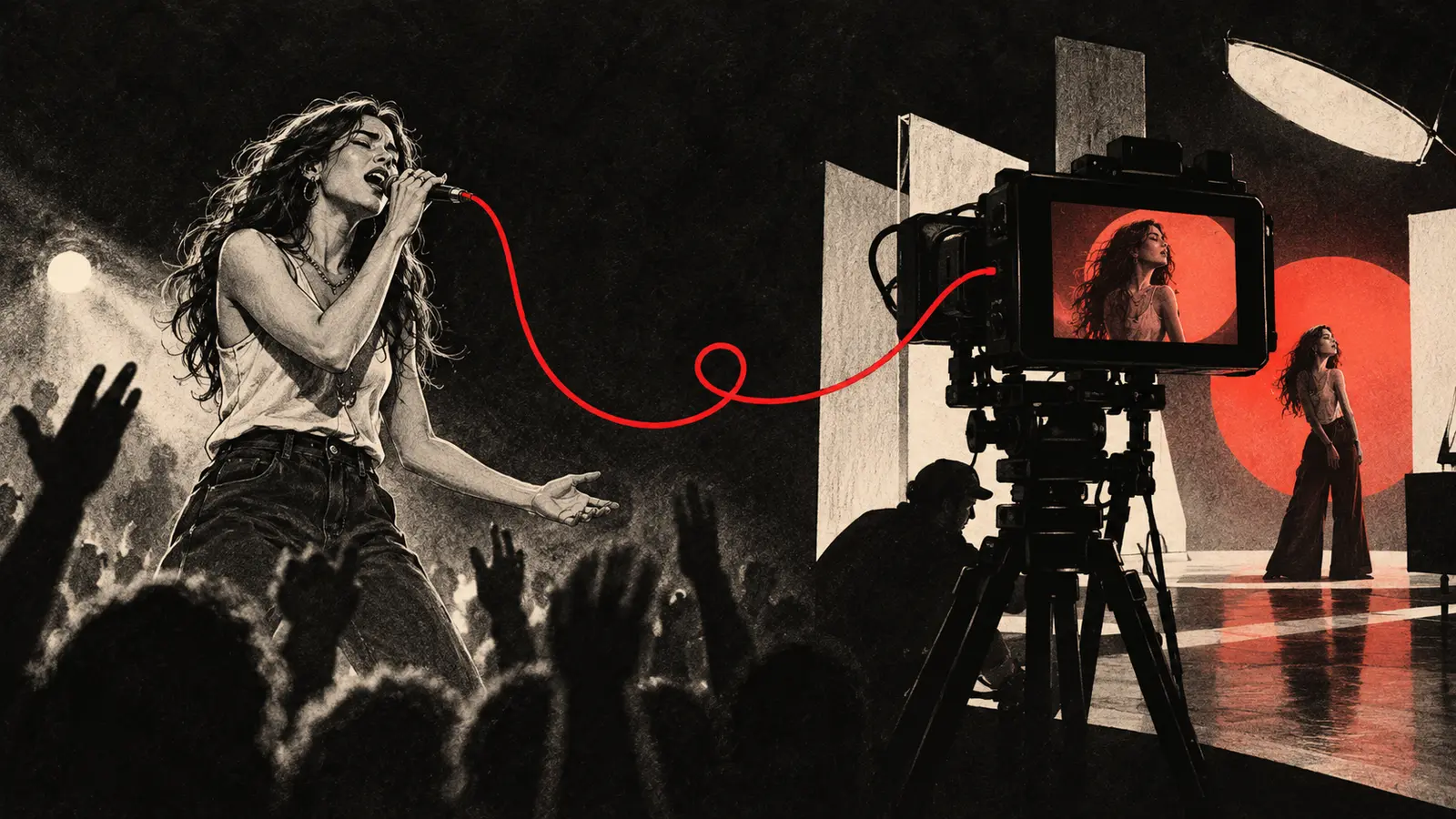
You finished the music video, it looks great, and the obvious move is to cut it down and run it as an ad. Then someone suggests a shaky phone clip from last month's show instead. Which one should get the budget?
There is no universal answer, and anyone who gives you one without testing is guessing. What you can do is understand what each format tends to communicate, prepare both fairly, and let a structured test decide. If you are unsure the track is ready for spend at all, read is your song ready for paid promotion first.
What each format signals to a viewer
Viewers make a judgment about an ad in a moment, often before they consciously register the music. The footage sets that frame.
| Performance footage | Music video clips | |
|---|---|---|
| First impression | Real, present, happening now | Crafted, cinematic, a release |
| What it proves | You can deliver the song live, people show up | The project has a world and an aesthetic |
| Native feel in feeds | Often blends in with organic posts | Can look clearly like an ad |
| Risk | Poor audio or framing can undersell the song | Slow openings or abstract shots can lose viewers |
| Best raw material | Crowd reactions, close vocal shots, clean board mix | Striking first frames, performance moments within the video |
Neither column is better. They answer different questions a potential fan might have: "Is this artist real?" versus "Is this world for me?"
When performance footage tends to make sense
Performance clips often fit when:
- the artist's live energy is a core part of the identity
- you have footage with a visible, engaged crowd
- the genre culture values authenticity and rawness
- you are promoting shows or want the ad to feel like an organic post
The weak point is audio. Phone recordings of loud rooms can turn a great song into mush. Whenever possible, sync the clip to the studio master or a clean board recording, and make sure the lip sync or playing matches. If it visibly does not, viewers notice.
When music video clips tend to make sense
Polished clips often fit when:
- the visuals are a big part of the song's appeal
- the video has a strong, readable first frame
- you are introducing a new era, look or concept
- the artist has little or no live footage yet
The weak point here is pacing. Music videos are edited to be watched from start to finish, not interrupted by a scroll. Opening shots are frequently slow establishing moments. For an ad, pull the most arresting frames forward, even if that breaks the video's original order.
Prepare both formats fairly
A comparison only means something if the two versions differ in the one way you care about. Before testing:
- Use the same audio segment. Same hook, same starting point, same loudness. Otherwise you are testing the song edit.
- Match length and aspect ratio. Crop both to the same vertical or square format and cut them to similar durations.
- Apply identical text. Same caption, same on-screen text, same call to action, or none on both.
- Lead with motion in both. Each version should open on something moving and relevant within the first second.
- Keep the landing destination identical. Same link, same page.
If you plan to promote on Instagram specifically, the placement notes in how to promote your music on Instagram help you choose a format that suits the feed.
Set up the test
- one campaign, one audience, one objective
- one ad per format, otherwise identical
- equal budget or fair delivery split
- a fixed test window agreed in advance
Resist the urge to call it after a day. Early delivery is uneven, and platforms often push one version before they have enough information.
If you have several strong performance clips and several video moments, do not throw them all in together. Pick the single best of each first. You can test variations within the winning format afterwards.
How to judge the result
The ad platform will show you watch time, retention in the opening seconds, and click-through. These tell you which format held attention and prompted action inside the feed. They do not tell you what happened after the click.
For that, look at your streaming analytics over the same window: saves, playlist adds by listeners, repeat listens, and followers. You cannot match individual ad viewers to individual listeners, but you can watch whether one test period coincides with healthier listening behavior than another.
Ask three questions:
- Which format held viewers better at the start?
- Did the clicks from that format look like real listeners, or just curious taps?
- Does the winner fit where the artist is going, not just this one campaign?
A raw live clip might win on attention but attract people who liked the vibe of the room rather than the recording. A polished clip might get fewer clicks but more saves. Neither result is wrong; they tell you different things.
A hybrid option worth testing
You do not have to choose purely one or the other. Some effective structures:
- Live open, video payoff. Start with a crowd moment for authenticity, cut to the most striking video shot on the hook.
- Video open, live proof. Start with a strong cinematic frame, then show a brief live clip as social proof.
- Behind the scenes. Footage from the video shoot, which feels personal but shows production value.
Treat a hybrid as its own variant in a later test, rather than mixing it into your first comparison.
Mistakes to avoid
- Using live audio that undersells the recorded song
- Opening the video clip on a slow establishing shot
- Adding captions to one version and not the other
- Declaring a winner from one day of data
- Assuming the result applies to every future release
FAQ
Do live clips always perform better because they look organic? No. They sometimes blend in better, but blending in is only useful if the clip still sells the song. Test rather than assume.
What if I only have a music video? Cut several different openings from it and test those. You can also film a simple performance or studio take later for comparison.
Should I use the same winner for every audience? Not automatically. A format that works for existing fans may not work for cold audiences. Retest when the audience changes meaningfully.
Plan your creative with Shuffle
Choosing between live footage and polished clips is one decision in a wider creative plan. If you want help structuring footage, tests and campaigns around your next release, apply to work with Shuffle.
Want this run on your release?
We take on a limited number of artists and labels, and we read every application ourselves.
Apply to Work With Us