
October 5, 2026 / 5 min read
When to Replace a Music Ad That Stops Working
How to tell normal swings from creative fatigue, rule out link and delivery problems, and refresh an ad without losing what the campaign learned.
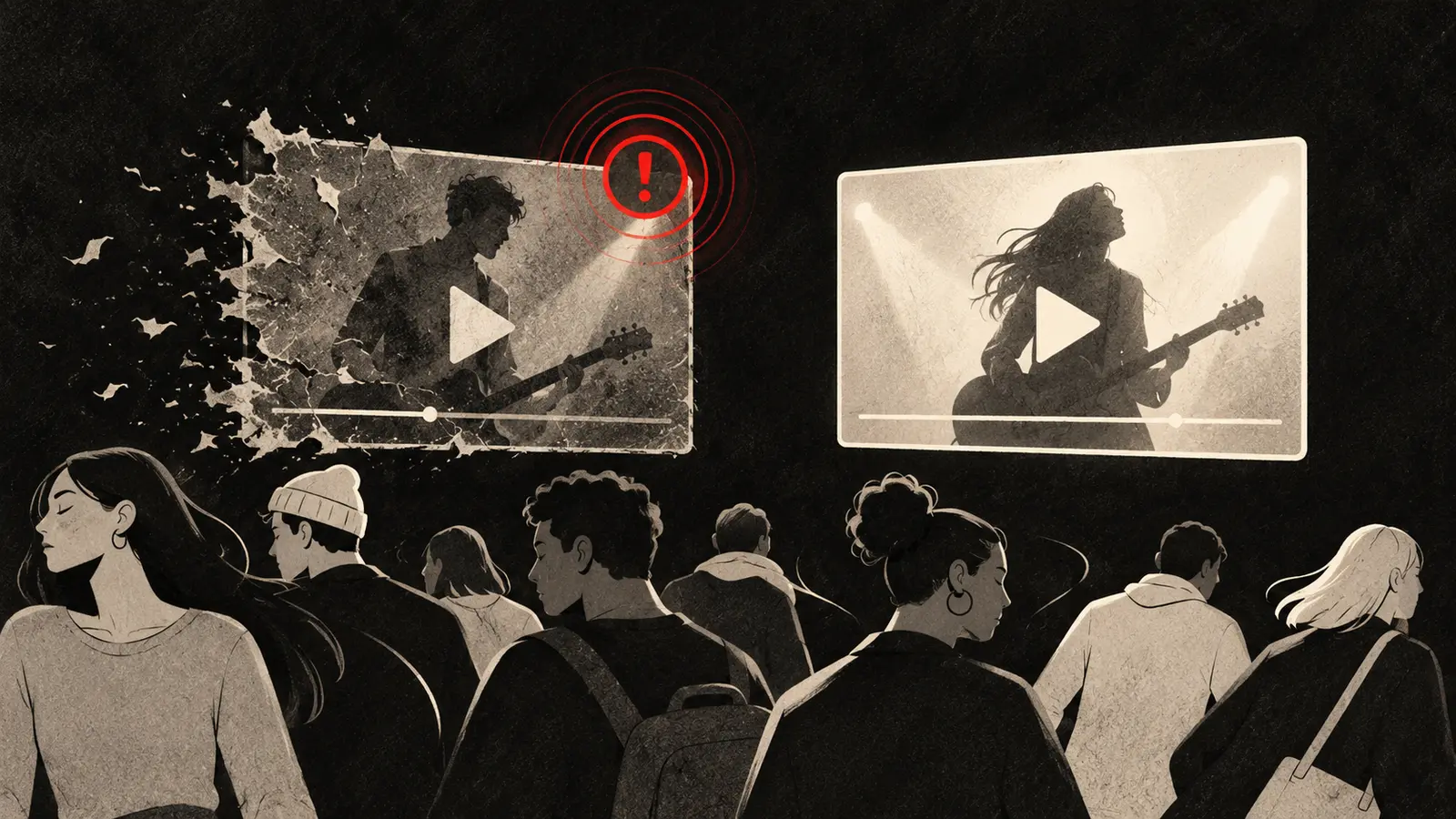
An ad that worked well for two weeks starts to slip. Clicks get more expensive, watch time drops, and the dashboard looks worse every day. The instinct is to kill it and start over. Sometimes that is right. Often it throws away a working campaign because of a problem that had nothing to do with the creative.
This guide helps you tell the difference between normal swings, creative fatigue and problems elsewhere, and then replace an ad without losing what you learned.
What creative fatigue actually is
Creative fatigue is when the people seeing your ad have seen it enough that it stops holding their attention. The same audience keeps getting the same video, and each new impression is worth less than the last.
It usually builds gradually. It is different from a sudden drop overnight, which more often points to a change in delivery, a broken link or something outside the ad.
First, rule out other causes
Before blaming the creative, check the rest of the chain. Many "dying ads" are actually one of these:
| Possible cause | What to check |
|---|---|
| Broken or slow landing link | Open the link on a phone, on mobile data, from the ad itself |
| Tracking or link change | Confirm the destination has not been edited or expired |
| Budget or bid change | Look for recent edits to budget, schedule or bid strategy |
| Audience change | Check whether targeting or exclusions were edited |
| Delivery or review issue | Look for disapproved ads, limited delivery warnings or policy flags |
| Seasonal or calendar shift | Holidays, major releases or events can change costs for everyone |
| Normal daily volatility | Compare against a longer window, not just yesterday |
If you find a problem here, fix it first and give the ad time to recover. Replacing the creative will not fix a broken link.
If clicks are fine but listening is not growing, that is a different issue. Why music ads get clicks but no listener growth covers that situation.
Signs that point toward fatigue
Once other causes are ruled out, these patterns together suggest fatigue:
- Frequency is climbing. The average person in your audience is seeing the ad more often over time.
- Early retention is falling. Fewer viewers stay past the opening seconds compared with the ad's first days.
- Click-through is declining steadily, not in one sudden drop.
- Costs rise gradually while nothing else in the setup has changed.
- Comments shift toward "I keep seeing this" or stop entirely.
One signal alone is weak evidence. Several moving together over a sustained period is stronger.
Check streaming behavior too
Ad platform numbers describe attention and clicks inside the feed. They do not describe listening.
Look at your streaming analytics over the same weeks: are saves, repeat listens and followers from the campaign period holding steady, or falling alongside the ad signals? If ad metrics are slipping but listening behavior is stable, the ad may still be doing its real job, just less efficiently. That is a reason to refresh thoughtfully, not panic.
Refresh or replace?
Not every tired ad needs a brand-new concept. There is a spectrum:
- Light refresh. Same concept, new opening frame, different hook timestamp, or new on-screen text. Useful when the idea still works but the first seconds feel familiar.
- New execution, same angle. Different footage telling the same story. Useful when the angle performed well and you have more material.
- New concept. A different angle entirely. Useful when the old idea has clearly run its course or never fit strongly.
Start as light as the evidence allows. A small change keeps what was working and tests whether novelty alone restores attention.
How to replace without losing learning
Replacing an ad badly can reset everything the campaign learned. A cleaner approach:
- Add, then retire. Introduce the new creative alongside the old one, let it gather delivery, and pause the old ad once the new one is running steadily.
- Change one thing. If you change creative, audience and budget together, you will not know what caused the result.
- Keep the winning elements. Carry forward the hook, angle or format that the original ad proved, unless you are deliberately testing something new.
- Log the reason. Record why you replaced it, what changed and what you expect to happen.
For the fundamentals of campaign structure that make this easier, see Meta ads for musicians.
Build a rotation before you need it
The easiest way to handle fatigue is to plan for it. When you brief creative, ask for more than you plan to launch. Keep two or three ready-to-run variations in reserve. When the first signs of fatigue appear, you can respond in a day instead of waiting for a new edit.
A simple rotation plan:
- launch with your strongest version plus one alternative
- keep one or two reserve edits ready
- review fatigue signals on a fixed schedule, such as weekly
- rotate in a reserve when several signals move together
Mistakes to avoid
- Killing an ad after one bad day
- Replacing creative when the real problem is the link
- Launching a completely new concept when a light refresh would do
- Pausing the old ad before the new one has any delivery
- Judging fatigue only from ad metrics and ignoring listening behavior
FAQ
How long does a music ad usually last before fatigue? It depends on audience size, budget and the creative. Smaller audiences and higher budgets tend to show fatigue sooner. Watch the signals instead of following a fixed timeline.
Can a fatigued ad come back later? Sometimes. After a break, or with a new audience, an older ad can work again. Keep it archived rather than deleting it.
Should I refresh for every new audience? Not necessarily. A new audience has not seen the ad, so fatigue does not apply yet. Refresh based on signals within each audience.
Keep your campaigns fresh with Shuffle
Spotting fatigue early and rotating creative smoothly keeps campaigns efficient across a whole release cycle. If you want a team to manage that for you, apply to work with Shuffle.
Want this run on your release?
We take on a limited number of artists and labels, and we read every application ourselves.
Apply to Work With Us