
November 16, 2026 / 6 min read
How to Set Order Deadlines for an Artist Holiday Merch Campaign
Work backwards from carrier and fulfillment inputs to set honest holiday merch order deadlines by region and product, then change over your campaign on time.
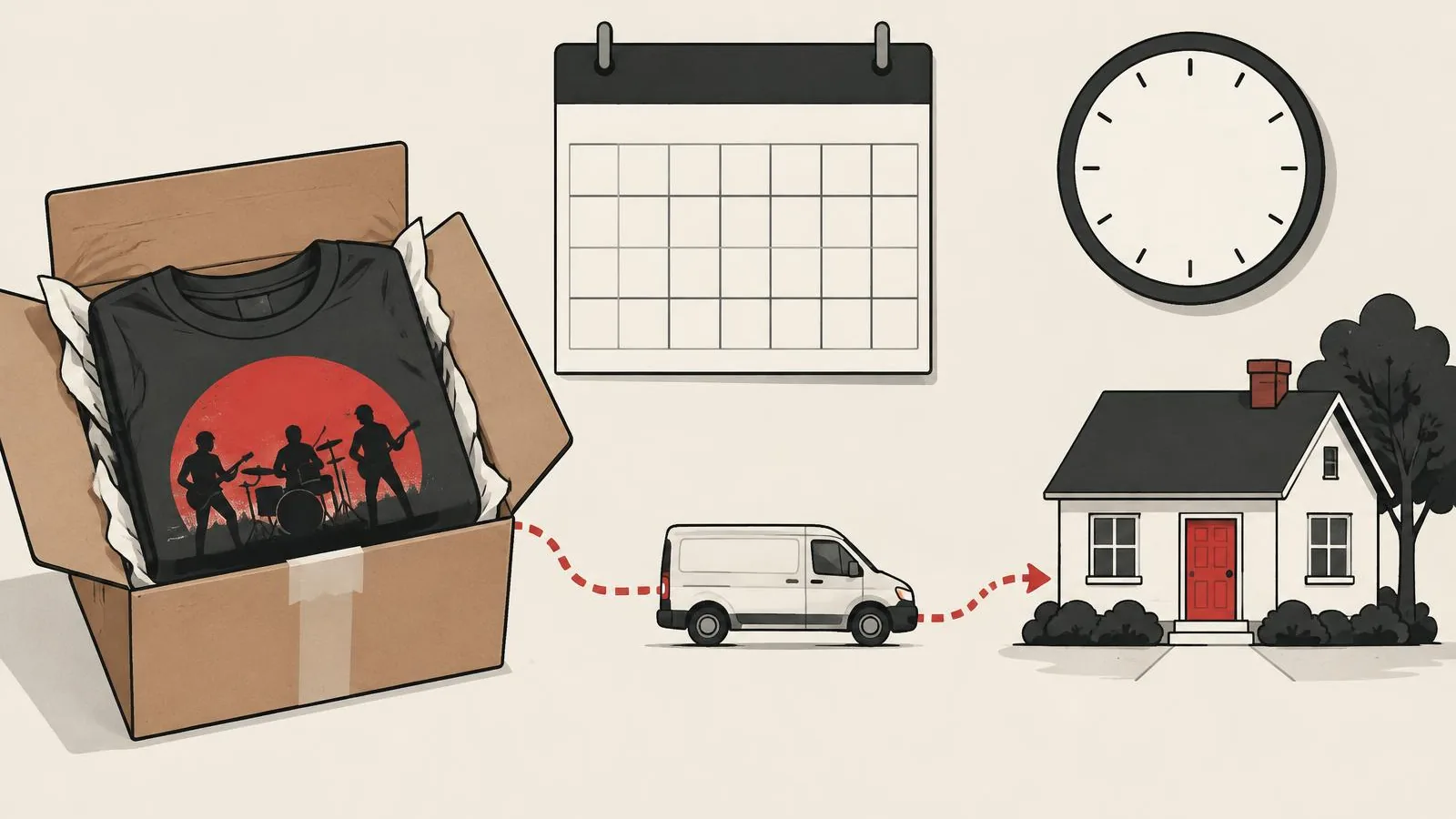
Set a holiday merch order deadline by working backwards from the date a buyer needs the item, subtracting carrier transit time, then subtracting your own processing time, and subtracting a separate buffer for each. Count in business days and remove closure days. The result is your last safe order date for each region and product. Your ads, product pages, and emails should all stop promising holiday delivery on that date, not on the day you hope things will work out.
This article covers deadline planning only. For choosing products, building the campaign, and measuring sales, read our general guide to promoting music merch with paid ads.
Why a deadline needs its own plan
Holiday buyers are often not your fans. They may be buying for a fan: a partner, a child, a friend. That person cares about one thing more than anything else, which is whether the gift arrives in time. A vague promise like "ships soon" does not help them decide.
At the same time, your timeline depends on people you do not control: a printer, a fulfillment partner, and one or more carriers. Each of them publishes their own holiday dates, which change every year. Your job is to collect those inputs, add your own processing time, and turn them into a date you can honestly state.
Gather the inputs
Before you write a single ad, fill in these fields for every product and every region you ship to.
From your production or fulfillment partner
- Last date they accept new holiday orders, if any.
- Typical processing time per order during the season. Ask specifically about the holiday period; it may differ from the rest of the year.
- Whether print-on-demand items, pre-printed stock, and signed or personalised items have different times.
- Days they are closed.
From each carrier
Carriers publish seasonal ship-by dates. In the United States, USPS lists its holiday ship-by dates by service each year. Other carriers and national postal services publish their own. Canada Post, for example, posts service alerts that may affect delivery. Use the current year's published dates, not last year's, and note that these are usually recommended dates, not guarantees.
From your own operation
- Who packs or approves orders, and which days they are unavailable.
- How long customer questions take to answer.
- Whether you need extra time to check stock before an order is released.
Build the backward plan
Here is the worksheet. Fill one row per product type per region.
| Field | What to write |
|---|---|
| Target delivery date | The date the buyer needs it, for example before a holiday |
| Carrier ship-by date | From the carrier's current published list for the chosen service |
| Transit buffer | Extra days you add for carrier uncertainty |
| Processing time | From your partner, for the holiday period |
| Processing buffer | Extra days for your own approvals, stock checks, and closures |
| Last safe order date | Ship-by date minus transit buffer, minus processing time, minus processing buffer, counted in business days and skipping closures |
Keep the two buffers separate. If something goes wrong, you will want to know whether it was transit or processing. Combining them hides that.
Account for geography and variants
One deadline for everything is simpler to communicate and often wrong.
- Domestic and international shipments usually have different ship-by dates. International orders may also face customs checks that add time you cannot predict precisely.
- Remote regions within a country can take longer than major cities.
- Variants matter. A standard t-shirt and a custom embroidered jacket may come from different partners with different processing times.
- Bundles ship at the speed of their slowest item.
Where deadlines differ, show them clearly on the product page and in the ad copy where possible. If they become too complicated to communicate, consider limiting holiday delivery promises to the regions and products you can manage confidently.
Speak to gift buyers and fans differently
Your existing fans know who you are. Gift buyers may not. Adjust the message:
- For fans: One short line naming the region and the exact last order date for holiday delivery. Specific beats friendly.
- For gift buyers: Make it clear what the item is, what sizes exist, and the deadline. A gift buyer unsure about size may delay and miss the window.
Offer an alternative after the deadline. A digital gift card, a downloadable item, or a clear "arrives after the holidays" option keeps the sale without making a promise you cannot keep.
Write delivery language carefully
Avoid wording that sounds like a guarantee unless you can back it up. "Order by this date for estimated holiday delivery" is more honest than "guaranteed by Christmas." Carriers can and do experience delays, and you are responsible for what your store promises.
Check the consumer rules that apply where you sell with qualified advice. This article is not legal advice.
Plan the campaign cut-off and changeover
On the last safe order date, several things should change at once. Write the list in advance:
- Pause or edit ads that mention holiday delivery.
- Update product page banners.
- Change email and link-in-bio copy.
- Switch to the post-deadline offer, if any.
- Tell whoever answers customer questions.
New or edited ads may need to pass review before they run, so prepare the replacement versions in advance and confirm they are approved and live before the cutoff. Our guide to audience exclusions explains how to stop recent buyers from seeing the same offer again.
A hypothetical example
An artist sells a hoodie printed on demand and a signed CD packed at home. Their partner quotes several business days of processing for the hoodie during the season. The CD is packed within two days, but the artist is travelling for a week in mid December.
They build two rows on the worksheet for domestic orders and one for international. The hoodie's last safe order date ends up several days earlier than the CD's. International holiday delivery is not offered for the hoodie because the combined buffers leave no room. The artist states each deadline on its product page, and the changeover list is scheduled for the day before the earliest deadline.
This is an illustration of the process. It does not use real carrier dates.
Limitations
This plan reduces the risk of late deliveries; it does not remove it. Carrier dates are recommendations, partners can fall behind, and weather or volume can cause delays. Ad platforms show clicks and purchases their tracking can see; your store shows actual orders. Use your store records as the source of truth.
FAQ
How much buffer should I add?
There is no universal figure. Base it on how reliable your partner and carrier have been for you, and add more where you have little history.
Should I stop selling after the deadline?
Not necessarily. Keep selling with clear "after the holidays" delivery language, or offer a digital alternative.
Can I use one deadline for every country?
Only if the earliest deadline among them is acceptable for all. Otherwise state separate dates.
Get help planning the season
To see how we connect merch, music, and paid campaigns, explore our services or apply to work with Shuffle.
Want this run on your release?
We take on a limited number of artists and labels, and we read every application ourselves.
Apply to Work With Us