
November 9, 2026 / 5 min read
How to Build an Audience Exclusion Strategy for Music Ads
Separate music ad prospecting, engagement and purchase audiences with supported exclusions, clear event definitions and a practical overlap review.
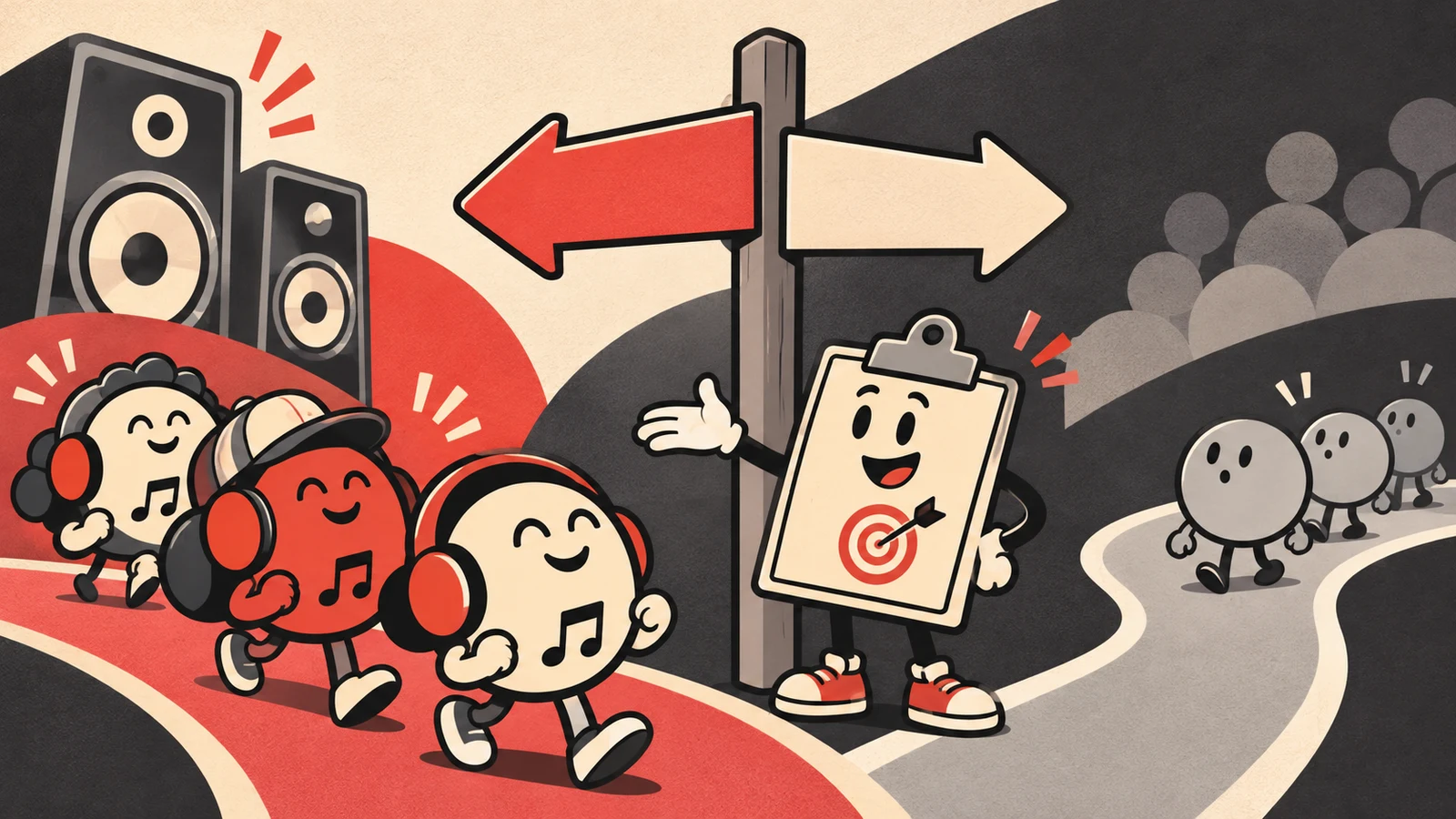
Build an audience exclusion strategy for music ads by deciding which people should not receive each message, using only supported audience signals and controls. Separate new discovery from follow-up, define what counts as a recorded conversion, and give purchasers an appropriate next step. Exclusions help reduce competing messages and redundant spending, but they do not guarantee perfect separation. Audience matching, consent, eligibility, and reporting limitations all matter. Start with a simple audience map rather than a complicated stack of rules you cannot verify.
Define stages using observable signals
A useful map separates prospects, platform-engaged people, website visitors, recorded converters, and purchasers. These are operational labels, not proof of a person's relationship with the music.
A video viewer may have watched briefly. A website visitor may not have opened a streaming service. A streaming-button click records an attempted handoff, not a verified stream or save. A merch purchase is a different outcome again.
Use music campaign metrics beyond clicks to define each event honestly. Never build a “verified Spotify listeners” exclusion from outbound clicks and then describe it as if the streaming service confirmed those identities.
Write down each audience's source
For every group, document the platform or website event, eligibility, membership window, consent requirements, and refresh behavior. Name audiences so the source is visible. “Recent site visitors” is more accurate than “real fans” when page visits are all you observe.
Aggregate streaming analytics can guide campaign interpretation, but they do not supply a portable individual listener list for matching on unrelated advertising platforms. Keep that boundary explicit in briefs and reports.
Assign an exclusion purpose to each campaign
Prospecting may exclude eligible recent converters when the intention is to find new action-takers. Follow-up may include engaged visitors while excluding people who already completed the specific action. A merch campaign may exclude recent purchasers of the advertised item where supported.
Do not turn those examples into mandatory rules. An existing supporter can still be a relevant audience for a new release. Someone who clicked one track's link has not necessarily completed the objective for another track.
Define the action, offer, and timeframe together. The question is not “How do we remove all fans?” It is “Who would find this exact message redundant or inappropriate right now?”
Check what the platform really enforces
Restrictions and suggestions are different
Some automated audience products use selected audiences as suggestions and can expand beyond them. A suggestion is not the same as a strict inclusion boundary. A supported exclusion is a separate control whose behavior you must confirm in the selected setup.
Meta's Custom Audience exclusion guidance and Advantage+ audience guidance illustrate why these distinctions matter. Availability depends on campaign setup; do not assume old instructions still match every interface.
Account and campaign eligibility matter
Other platforms also apply campaign-type and policy requirements to audience tools. Google's Customer Match policy describes eligibility conditions. Do not promise a customer-list exclusion before checking that the account and intended campaign can use it.
Review the actual delivery settings, not only the audience library. An audience can exist without being usable in the way your plan assumes. Document unavailable controls as limitations rather than disguising an approximate workaround as a hard exclusion.
Use consented data responsibly
Customer lists and website events require lawful collection and permitted advertising use. Check applicable privacy obligations and platform terms, including consent requirements where relevant. Hashing identifiers is a technical processing step, not a substitute for permission.
Avoid uploading data obtained for an unrelated purpose without reviewing whether that use is allowed. Honor applicable deletion and consent requests. Keep sensitive personal details out of campaign names, tracked URLs, and shared reporting sheets.
Our guide to owning fan contacts explains the value of a direct relationship. That value depends on treating supporters' information responsibly, not treating every contact as an unrestricted targeting asset.
Start with a simple exclusion matrix
Create a small table in your campaign planning document with these columns:
- Campaign and intended action.
- Eligible included audience or targeting approach.
- Audience to exclude and the reason.
- Membership window and source event.
- Control availability and last verification date.
- Owner responsible for updates.
For a hypothetical single, prospecting might introduce the song to a broad eligible audience while excluding recent recorded landing-page action-takers. A follow-up campaign might address recent visitors who did not record that action. Describe the conversion as a landing-page action, not as verified listening.
If the available audience is too small or the setup cannot enforce the distinction, simplify. Complexity is not evidence of better targeting.
Review overlap and competing messages
Before launch, inspect sibling campaigns for contradictory invitations. One campaign might request a first visit while another asks the same eligible audience to return. A product ad may continue after the advertised variant is unavailable.
Check audience definitions, windows, exclusions, destinations, and creative promises together. Where platform reporting offers useful overlap or delivery information, use it, but do not infer perfect person-level separation from incomplete reports.
Pair this review with retargeting after the first ad click. The goal is to make follow-up useful, not simply to chase everyone who touched the campaign.
Monitor and revise the rules
Inspect whether event collection works, audience membership refreshes, and campaign delivery remains viable. Consent choices, identity matching, and data delays can all limit coverage. An exclusion audience is not necessarily an exhaustive list of everyone who acted.
Review performance using consistent periods and annotate rule changes. If reach falls sharply, investigate whether exclusions became too broad or whether the eligible audience is genuinely small. Avoid removing every restriction at once without understanding the cause.
For ecommerce, reconcile purchase events against store orders before relying on purchaser exclusions. Incorrect or duplicated events can distort both reporting and audience membership.
FAQ
Should I exclude everyone who clicked the ad?
Not automatically. A click does not prove the desired outcome. Decide whether that person needs a different message, and use a supported event definition that matches the next campaign's purpose.
Can exclusions eliminate all overlap?
No. Controls have scope and data limitations, and separate platforms do not share a complete identity map. Treat exclusions as practical delivery rules, not a guarantee of perfect separation.
How long should an exclusion last?
Choose a window tied to the action and offer. A recent purchase of one item differs from engagement with an older song. Document the choice and review evidence rather than presenting a universal duration.
Make audience rules serve the release
For help aligning prospecting, follow-up, and purchase messages with an accurate audience map, apply to work with Shuffle. Bring the current campaign structure and the events your setup can reliably observe.
Want this run on your release?
We take on a limited number of artists and labels, and we read every application ourselves.
Apply to Work With Us