
October 21, 2026 / 5 min read
Spotify vs YouTube: Where Should Music Ads Send Fans?
A practical comparison of Spotify and YouTube as destinations for paid music traffic, and how to choose based on your goal.
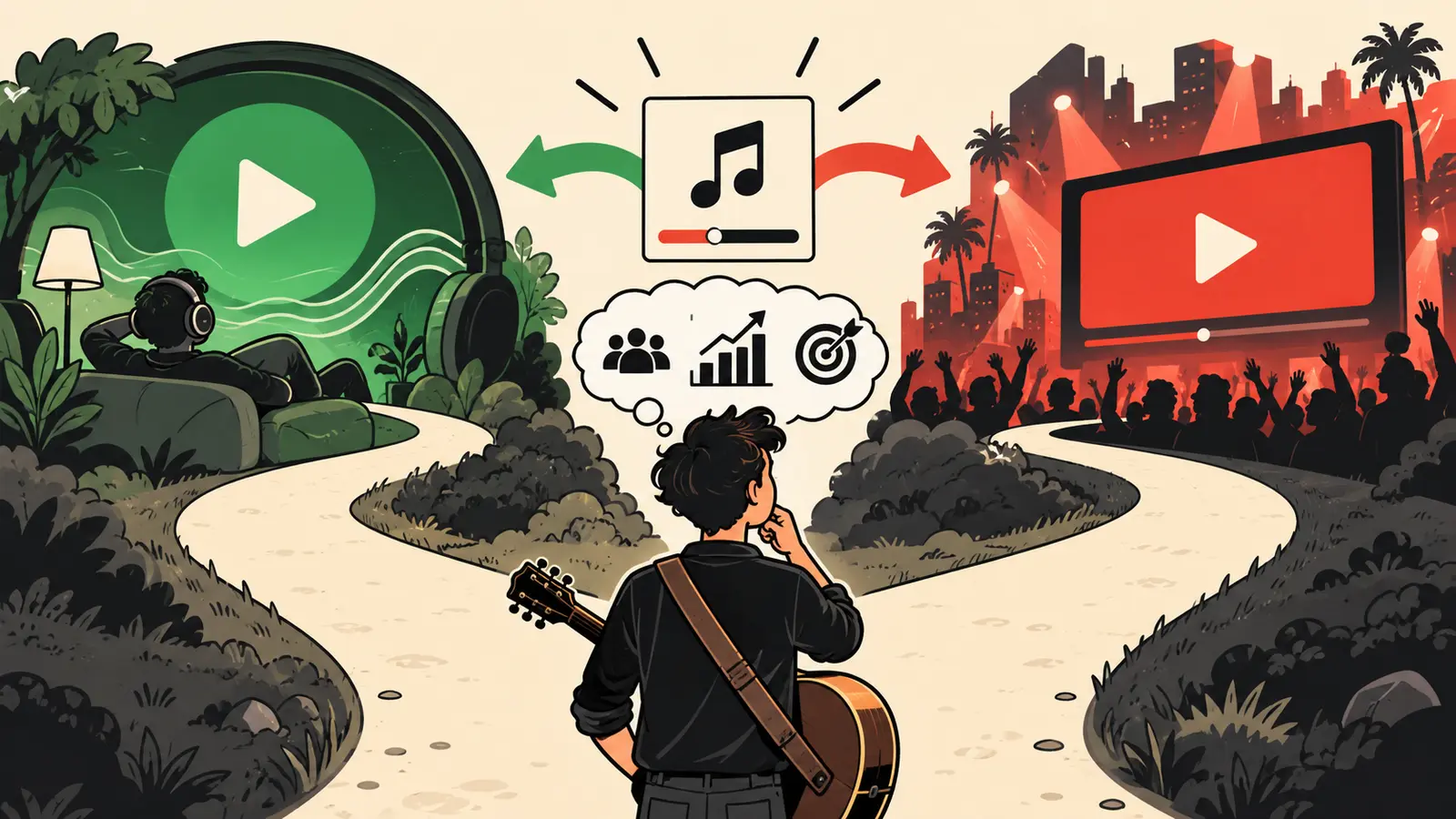
Whether music ads should send fans to Spotify or YouTube depends on what you want the campaign to achieve. Send traffic to Spotify when the goal is listening behavior inside a streaming library: saves, follows and repeat plays. Send traffic to YouTube when the goal is watching: video views, channel subscribers and building an audience that engages with visual content. Your creative, your audience's habits, how you will measure and where you are in the release cycle should all shape the choice.
There is no single right destination. This guide compares the two across the factors that actually decide it.
Start with the campaign objective
Before picking a destination, write down the one outcome the campaign is meant to move.
- Grow listeners who save and return. Spotify is usually the more direct destination, because saves, playlists in a listener's own library and follows happen there.
- Grow subscribers and views. YouTube is the natural destination, since subscriptions and watch time live there.
- Promote a music video or visual project. YouTube fits, because the work is meant to be watched.
- Promote an audio-first release. Spotify often fits, because the listener does not need a screen.
If you cannot name a single objective, the campaign is likely to send mixed traffic to both and learn little from either.
Compare the destinations
Spotify
Spotify is built for listening. A person who arrives can play the song, save it, add it to their own playlists and follow the artist in a few taps. Those actions can feed into how the song is surfaced to that listener later.
Strengths:
- Saves and follows are clear intent signals.
- Listening continues in the background while the person does other things.
- Spotify for Artists gives you listener data by market and source.
Limits:
- Ad platforms cannot see what happens after someone leaves your page for the app. You rely on separate Spotify data to understand listening.
- People without the app installed may hit friction.
YouTube
YouTube is built for watching. A person can watch, subscribe, comment and move to your next video without leaving the platform.
Strengths:
- When you run ads on YouTube itself, Google Ads reports views, engagement and subscriber actions in the same ecosystem.
- Video creative and destination match.
- Your channel builds a library people can keep returning to.
Limits:
- Listening on YouTube often requires keeping the screen on, which can reduce background listening.
- A view and a lasting listener are not the same thing.
Our guide to YouTube ads for music promotion and our article on YouTube Shorts campaigns that generate subscribers go deeper on that side.
Match the creative to the destination
Creative and destination should make the same promise.
- A short vertical clip built around a hook often pairs well with a listening destination, because the next step is simply to hear more.
- A cinematic music video cut often pairs well with YouTube, because the viewer expects to keep watching.
- Performance footage can work for both, depending on what you ask the viewer to do next. See performance footage vs music video clips.
If the ad shows a full visual story and then sends people to an audio-only app, some will feel the mismatch. If the ad sells the sound and then drops people into a long video, some will not wait.
Consider audience intent and habits
Different audiences prefer different platforms. Some listeners live in Spotify. Others discover and replay music mostly on YouTube. Signals to look at:
- Where your existing listeners already come from in Spotify for Artists and YouTube Studio.
- Which platform your genre's fans tend to use, based on your own data rather than assumptions.
- Market differences. Platform preference can vary by country, so check the data for the markets you target.
When you are unsure, a landing page offering both can help. Our guide on one or several streaming buttons covers when that choice helps and when it splits attention.
Plan measurement before launch
The destination determines what you can measure.
- Spotify traffic from Meta or TikTok ads: you can measure ad engagement and landing page events with a pixel. Listening behavior comes from Spotify for Artists, as a second view. Our article on Spotify ad clicks vs streams explains why those numbers differ.
- YouTube ads to a YouTube video: views and subscriber actions are reported within Google's systems, though you still need to judge whether viewers return.
Write down which metric decides success for each destination. Our guide to music campaign metrics that matter beyond clicks explains what each one proves.
Use the release stage
Release stage often changes the answer.
- Before release: a pre-save on Spotify or a premiere or teaser on YouTube both build anticipation. Choose based on where your audience will listen at launch.
- Release week: many campaigns concentrate on one main destination to avoid splitting attention. Our music release campaign timeline covers that week.
- After release: if a music video launches later, YouTube can become the focus while Spotify continues as the listening home.
A quick decision table
| If your priority is | Lean toward | Measure with |
|---|---|---|
| Saves, follows, repeat listening | Spotify | Spotify for Artists alongside ad data |
| Subscribers and watch time | YouTube | Google Ads and YouTube Studio |
| A music video launch | YouTube | Views, retention, subscribers |
| An audio-first single | Spotify | Saves, listeners by market |
| Unclear audience preference | Landing page with options | Button taps by platform |
Common mistakes
- Sending one campaign to both at once without a way to compare them.
- Mismatched creative and destination.
- Comparing numbers from different systems as if they measured the same thing.
- Choosing by habit instead of objective.
Frequently asked questions
Can I run both at the same time?
Yes, as separate campaigns with separate objectives and budgets, so you can read each one clearly.
Which is cheaper?
Costs depend on audience, creative, market and objective. Test with your own campaigns rather than relying on general claims.
Should a new artist start with one?
Usually yes. One destination makes it easier to learn what works before adding a second.
Choose the right destination with Shuffle
If you want help deciding where your next campaign should send fans, see our services or apply to work with us.
Want this run on your release?
We take on a limited number of artists and labels, and we read every application ourselves.
Apply to Work With Us