
October 21, 2026 / 6 min read
How to Build a Music Release Campaign Timeline
A week-by-week plan for running paid campaigns around a release, from three weeks out to the first seven days after the song is live.
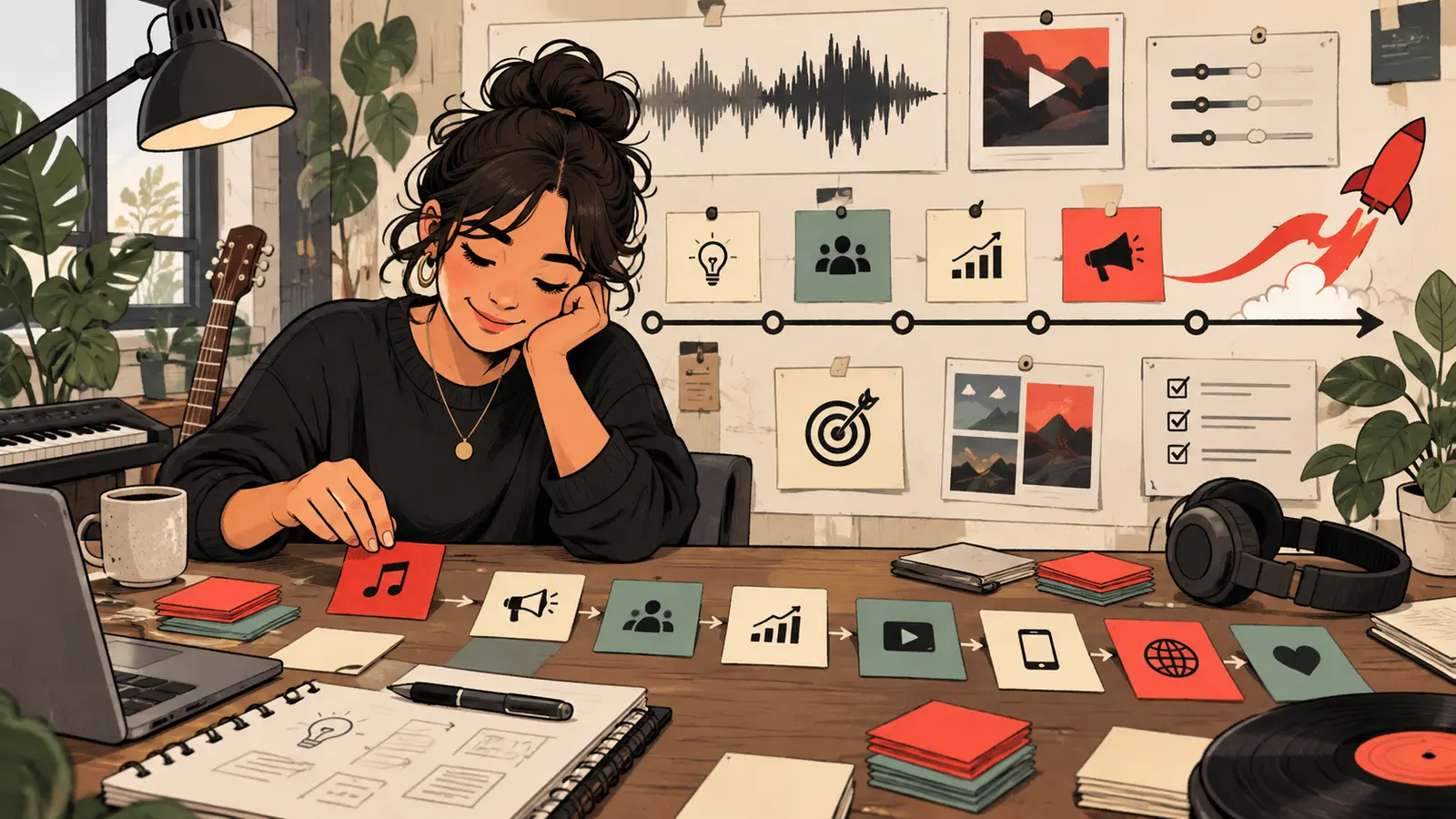
A music release campaign timeline should start about three weeks before release day, concentrate spend and attention in release week, and keep running with a clear review through the first seven days after the song is out. Three weeks gives you time to prepare assets, warm an audience and fix tracking before the moment that matters most. The first seven days after release then tell you which audiences, creatives and markets deserve the next round of budget.
This guide walks through that window day by day in practical terms. It is narrower than a full release strategy: if you want the six weeks to three months view, read our music release strategy checklist. Here we focus on the campaign itself.
Before the clock starts: what must already be true
A timeline only works if the basics are settled before week three. Check these first:
- The song is final. Master, artwork and metadata are delivered to your distributor, with a release date confirmed. Changing the date mid-campaign breaks every schedule below.
- You know the hook. The few seconds that will open your ads are chosen. Our guide on how to choose the song hook for a music ad covers how to pick them.
- The song is ready for paid traffic. Not every track is. Read how to know if a song is ready for paid promotion before committing budget.
- Tracking is installed. Your pixel or tracking tags fire on the landing page, and you know which event you will optimize for.
If any of these are missing, fix them before you start counting down.
Three weeks before release: build the foundation
Week three is about preparation, not reach. Spending heavily now usually wastes money because there is nothing to listen to yet.
Produce creative in batches
Brief your editor for several distinct variations, not one polished video. Different openings, different footage and different text overlays let the platforms find what works. Our guide to briefing a video editor for music ad variations explains how to structure that brief. Plan for at least one set of performance or behind-the-scenes clips alongside any music video cuts, since the two often behave differently in feeds. See performance footage vs music video clips for the tradeoffs.
Build the pre-release destination
Set up a pre-save or pre-release landing page that works on a phone. Test it as a stranger would, on a real device. Our mobile landing page test is a good checklist for this step.
Start small awareness tests
Run low-budget tests on short clips to existing followers and close lookalike or interest audiences. The goal is to learn which creative earns attention, not to drive results yet. Keep the budget modest so mistakes are cheap.
Two weeks before release: find the signal
By now the first tests have data. Use it.
- Pause clear losers. Creatives that nobody watches past the first seconds rarely recover.
- Note which markets respond. Response by country or city tells you where to concentrate release week spend.
- Grow the warm pool. People who watched most of a clip or engaged with a post become your release week audience. Make sure these audiences are being collected on each platform.
- Run pre-save ads to warm viewers. Pre-saves are a useful intent signal. Our guide to Spotify pre-save and release week ads covers this phase in detail.
One week before release: lock the plan
The final pre-release week is about decisions, not new experiments.
- Choose the two or three creatives you will lead with on release day.
- Confirm the destination for release day. Decide whether ads point to a smart link or a direct listening link, and why. Our comparison of Spotify smart links vs direct links can help.
- Prepare the release day landing page so it swaps from pre-save to listen at the right moment.
- Write down your budget split for release week and the first seven days, so you are not deciding under pressure.
- Tell your existing fans the date through every channel you own, including email or SMS if you have a list.
Release week: concentrate attention
Release day and the days around it are when you have the most to say. This is where most of the budget should go.
Release day
Start with the warm audience: people who pre-saved, engaged with clips or visited the landing page. They are the most likely to listen first. Then open up to colder audiences with the creatives that tested best. Check that every link points to the live release, not the pre-save.
Days two to four
Watch for problems more than results. Broken links, rejected ads and creatives that suddenly stop delivering are easier to fix early. Avoid large budget swings on day-to-day noise. Platforms need some stability to learn.
The first seven days after release: hold, then read
The week after release is where many campaigns get cut too early or scaled too fast.
Keep steady delivery
Hold budgets roughly level unless something is clearly broken. Rotate in a fresh creative if the leading ones show fatigue, such as rising costs alongside falling engagement. Our guide on replacing music ad creative fatigue explains the signs.
Read two sources, not one
Ad platform reports tell you what happened inside the ad: views, clicks and landing page events. Streaming platform data tells you what listeners did after. These do not always line up, and they are not meant to. Our article on Spotify ad clicks vs streams explains why.
Day seven review
At the end of the first week, write a short review covering:
- Which creatives earned the lowest cost per qualified action.
- Which markets responded, both in ads and in streaming data.
- Whether saves, follows and repeat listening moved, not just clicks.
- What you would change for the next release.
A simple timeline you can copy
| When | Focus | Key output |
|---|---|---|
| Three weeks out | Creative and destination | Ad variations, mobile-tested page, tracking live |
| Two weeks out | Testing | Winning creatives and markets identified |
| One week out | Decisions | Release day creatives, links and budget locked |
| Release day | Warm audience first | Live links, concentrated delivery |
| Days two to seven | Stability and review | Fatigue managed, two-source review written |
Common mistakes
- Spending big before release. Without a song to hear, most of that money buys nothing lasting.
- Changing everything on day two. Early data is noisy. Fix broken things, leave working things alone.
- Judging only by clicks. A click is a start, not a listener. Look further down the funnel.
- Skipping the review. The first seven days are the cheapest research you will get for the next release.
Frequently asked questions
Is three weeks enough time?
For a single with assets already made, usually yes. For an album or a first release with no audience at all, starting earlier gives you more time to build a warm pool.
Should the budget be split evenly across the weeks?
Usually not. Pre-release testing can stay small, with the larger share going to release week and the first seven days.
What if the song does not respond?
Check the creative, the destination and the audience in that order before deciding the song is the problem. Our guide to music ads with clicks but no listener growth walks through that diagnosis.
Plan your next release with Shuffle
If you want a campaign timeline built and run around your next release, see our services or apply to work with us. We take on a limited number of artists and labels and review every application ourselves.
Want this run on your release?
We take on a limited number of artists and labels, and we read every application ourselves.
Apply to Work With Us